
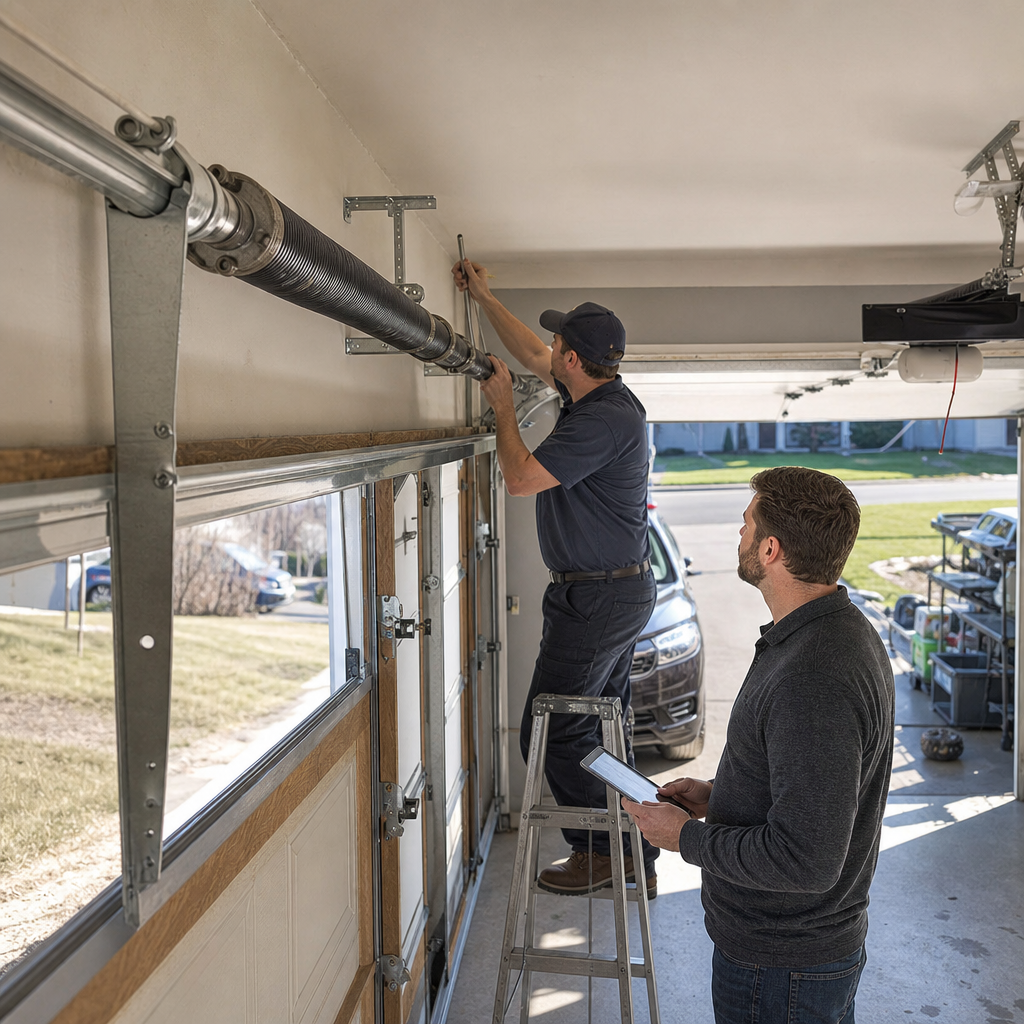
Garage Door Cable Replacement in West Virginia: Same-Day Service from $115–$225
Garage door cable replacement in West Virginia typically runs $115–$225 and is usually completed in under two hours. Because a snapped cable immobilizes the door completely and often traps a vehicle, we treat these calls as urgent — call (855) 934-0471 and Douglas Ross, Owner and Lead Technician, will diagnose whether you’re dealing with a torsion system lift cable or extension system safety cable before quoting an exact price. Most West Virginia homeowners don’t realize their cables are failing until one snaps, because the damage starts internally where humidity and freeze-thaw cycles do their work out of sight.
Why West Virginia’s Climate Eats Garage Door Cables Faster Than You’d Expect
We’ve pulled cables in South Charleston that looked fine from the driveway but were down to three strands internally — the outer wrap held together just long enough to get the door halfway up. That’s the thing about garage door cable failure in our state: the humidity from spring rains seeps into the cable core, then hard winter freezes expand those moisture pockets into micro-cracks. By the time you see rust or fraying on the surface, the cable’s already compromised past the point where a partial repair makes sense.
The temperature swing matters too. A door in Morgantown might cycle through a 40-degree range in a single March week. That thermal expansion and contraction works the cable against the drum and pulley hardware constantly, accelerating wear that the manufacturer’s cycle rating assumes happens in more stable conditions. When wear becomes severe, Garage Door Roller Replacement in West Virginia, WV may also be needed to restore smooth operation. We’ve found that cables on West Virginia doors often need replacement at 60–70% of their rated lifespan — not because the cable itself is defective, but because our galvanic corrosion environment attacks the drum hardware first, creating rough surfaces that chew the cable from the outside while the climate weakens it from within.
Homes in the Kanawha Valley and along the Monongahela River corridor see this most acutely. The combination of older housing stock — many detached garages built in the 1960s and 70s with original or second-generation door systems — plus our specific humidity profile means we encounter cable-drum corrosion as the primary failure mode far more often than simple cycle exhaustion. When Douglas Ross inspects a cable job, he’s checking the drum surface, the bearing wear, and the bottom bracket condition, not just swapping the obvious broken part.
Torsion Cables vs. Extension Safety Cables: Two Different Failures, Two Different Risks
Most generic pages treat “garage door cable” as one thing. There are actually two distinct systems in West Virginia homes, and confusing them leads to either the wrong repair quote or a genuinely dangerous mismatch.
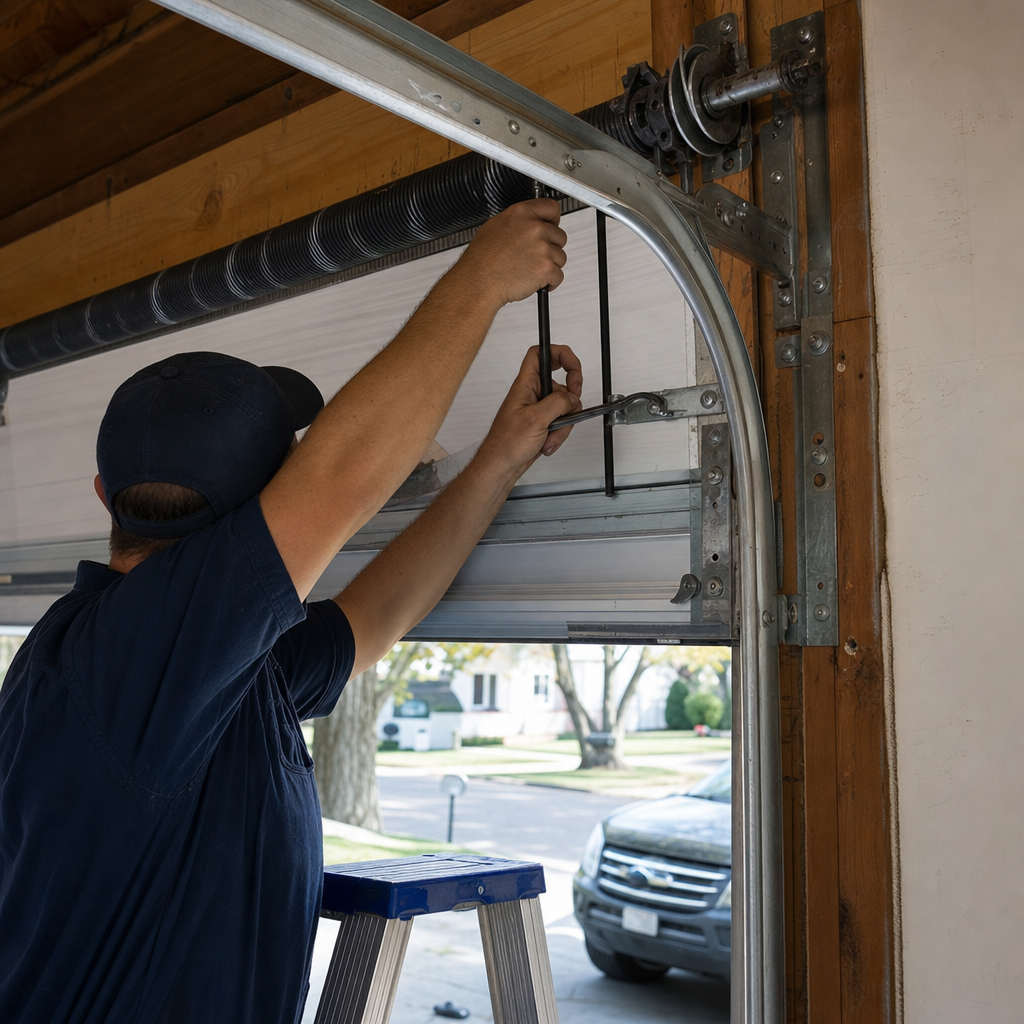
Torsion system lift cables do the actual lifting. They’re wound drums at each end of a spring-loaded shaft above the door. When these fail, the door drops hard and unevenly — usually jamming in the tracks or crashing to one side. The remaining cable takes double tension instantly, which is why we always replace torsion cables in matched pairs even when only one has snapped. Asymmetric tension warps the door panel geometry within a few cycles and almost always pulls the door off-track shortly after.
Extension system safety cables run through the center of extension springs mounted parallel to the horizontal tracks. Their job isn’t lifting — it’s containment. If an extension spring breaks, the safety cable catches the broken pieces before they fly across the garage. We’ve found extension safety cables frayed nearly through in Huntington homes where the homeowner didn’t know to check them, because they don’t affect door operation until they fail catastrophically. A broken safety cable with a worn extension spring is how garage doors put holes in drywall — or worse.
- Torsion lift cables: visible wear, immediate door failure, loud bang when they snap
- Extension safety cables: hidden inside spring coils, silent deterioration, catastrophic secondary damage when they let go
- Both systems in West Virginia: accelerated by humidity corrosion on drum/pulley hardware
- Both replacements: require releasing spring tension first — never a homeowner job
We stock Garage Door Parts including replacement cables for both systems, sized to the door weight and height. A standard 16×7 Clopay or Amarr door in a Charleston-area ranch home takes a different cable diameter than the lighter 8×7 doors common on older garages in Beckley’s hillside neighborhoods. Getting that spec wrong means premature failure or, on torsion systems, dangerous over-tension.
What Cable Replacement Actually Costs in West Virginia
Our pricing is straightforward because cable jobs don’t have hidden complexity once we’ve identified your system. Here’s what West Virginia homeowners actually pay:
| Service | Price Range |
|---|---|
| Cable Repair (single cable, paired replacement recommended) | $115–$225 |
| Cable Replacement Pair (torsion system, includes tension balance) | $180–$225 |
| Extension Safety Cable Set (both sides, includes spring inspection) | $140–$200 |
| Track Realignment (needed if asymmetric failure caused derailment) | $110–$215 |
| Spring Repair (often discovered during cable inspection) | $160–$305 |
| Roller Replacement (damaged during cable failure event) | $100–$200 |
The low end covers a straightforward pair replacement on a standard steel door with clean hardware. The high end accounts for drum replacement (corrosion damage), bottom bracket replacement, or track realignment when the door came down crooked. We don’t quote until we’ve inspected — every cable job includes a full tension system assessment because we’ve learned that fixing the cable without addressing the drum corrosion just brings us back in six months.
Our Garage Door Parts in West Virginia inventory includes cables for LiftMaster, Chamberlain, Genie, Clopay, Amarr, Wayne Dalton, Craftsman, and Raynor systems — the brands already on your home. No waiting on special orders for common sizes.
Can You Replace a Garage Door Cable Yourself?
No — and this isn’t contractor self-interest talking. Cable replacement requires releasing the spring tension that holds your door’s full weight. On a torsion system, that means winding down a shaft loaded with hundreds of pounds of torque using winding bars inserted into cogs. The wrong bar slips, the wrong move releases tension suddenly, and the hardware can break bones or worse. We’ve been called to jobs where a homeowner’s “simple” cable fix turned into a spring replacement, track damage, and an ER visit.
Extension systems seem safer because the springs are visible and accessible, but they’re under full extension load when the door is closed — which is when most people try to work on them. The safety cable is literally the only thing preventing spring pieces from becoming projectiles.
Douglas Ross handles cable replacement as part of a complete tension system assessment. We check spring balance, drum condition, bearing wear, and bottom bracket integrity. A quiet garage door is a safe garage door — let’s keep it that way. The extra fifteen minutes of inspection prevents the callback, and prevents you from paying twice.
How Do I Know If My Cable Is Failing Before It Snaps?
Look for these specific warning signs during your monthly door check — and yes, you should be checking monthly in West Virginia’s climate:
- Visible fraying or rust bloom on the cable surface, especially near the bottom bracket where moisture collects
- Door rises unevenly or one side lags — indicates one cable is stretching or slipping on a worn drum
- Excessive noise during operation — grinding or squealing from the drum area often means corrosion has roughened the surface
- Cable appears to “unwind” slightly from the drum when the door is fully open — a sign of drum groove wear or cable core failure
- Recent hard freeze followed by rapid thaw — this is when we see the most spring cable failures in Charleston and Huntington
If you spot any of these, don’t cycle the door more than necessary. A failing cable under load is unpredictable, and the secondary damage from a snapped cable — bent tracks, damaged panels, broken springs — costs far more than preventive replacement.
Why We Replace Cables in Pairs Even When Only One Failed
This is the most common question we get, and the answer is mechanical, not sales-driven. Cables are installed as matched sets with identical stretch characteristics. When one fails, the other has seen identical cycles, identical corrosion exposure, and identical wear patterns. It will fail soon — usually within weeks, sometimes within days.
More importantly, a new cable paired with a worn cable creates immediate tension imbalance. The new cable carries more load, the door rises crooked, the rollers bind in the tracks, and within a few cycles you’ve got off-track damage or a bent panel. We’ve seen homeowners who paid for a single cable replacement elsewhere, then paid us double to fix the resulting track and panel damage when the mismatch failed.
Our cable replacement price covers the pair for torsion systems, or both safety cables for extension systems. It’s not an upsell — it’s the only way to do the job without creating a callback.
Emergency Cable Failure: What Happens When You’re Trapped
A snapped cable usually immobilizes the door completely. If the break happens with the door open, it may crash to one side and jam in the tracks. If it happens closed, you’re not getting your vehicle out without manual release — and even then, the unbalanced door is dangerous to lift.
We treat cable failures as emergency garage door service, not an after-hours upcharge tier. When you call (855) 934-0471, you’re reaching Douglas Ross directly, not a dispatcher who’ll send whoever’s available. If you’re stuck in Parkersburg at 6 AM heading to work, or your door won’t close in Morgantown before a storm, we prioritize getting you operational.
Our emergency response includes full tension system inspection because cable failures rarely happen in isolation — the same conditions that snapped your cable have stressed your springs and drums. We fix the immediate problem and flag what’s coming next, so you’re not surprised by a spring repair in two months.
FAQs
Garage door cable replacement in West Virginia costs $115–$225 for most residential doors, with the typical job landing around $180 for a paired torsion cable replacement including tension balance. Extension safety cable sets run slightly lower. Call (855) 934-0471 for an exact quote — estimates are free.
Yes, same-day cable replacement is our standard response for West Virginia homeowners, and we treat trapped-vehicle situations as emergency calls. Douglas Ross carries Best Garage Door Parts in West Virginia, WV for LiftMaster, Chamberlain, Genie, Clopay, Amarr, Wayne Dalton, Craftsman, and Raynor systems on his service vehicle, so most jobs complete in a single visit without waiting on parts.
Replacement is the only safe option — garage door cables cannot be spliced or partially repaired. Once frayed or snapped, the entire cable must be replaced. Attempting to “repair” a cable by clamping or shortening it creates dangerous tension imbalance and violates basic mechanical safety. Our $115–$225 replacement range includes proper installation and system rebalancing.
West Virginia’s humidity and freeze-thaw cycles typically reduce cable lifespan to 60–70% of manufacturer ratings — often 5–7 years rather than the 8–10 expected in drier climates. Galvanic corrosion on drum hardware accelerates external wear, while internal moisture damage from our wet springs and hard winters causes the hidden core deterioration we’ve found in Kanawha Valley and Monongahela River corridor homes. Annual professional inspection catches this before failure.
Ready to Get Your Door Moving Again?
A snapped or fraying cable won’t fix itself, and every cycle on a compromised cable risks more expensive damage. If you need Garage Door Parts Near Me in West Virginia, WV, we keep common sizes in stock for fast service. Call (855) 934-0471 now for a free estimate — Douglas Ross, Owner and Lead Technician at Halcyon Garage Door Installation West Virginia, will diagnose your system, quote exact pricing, and handle the replacement personally. Nearly 600 five-star reviews built one door at a time over 11 years. Straightforward diagnosis, honest price, door done right.
Written by Douglas Ross, Owner & Lead Technician at Halcyon Garage Door Installation West Virginia, serving West Virginia, WV.