
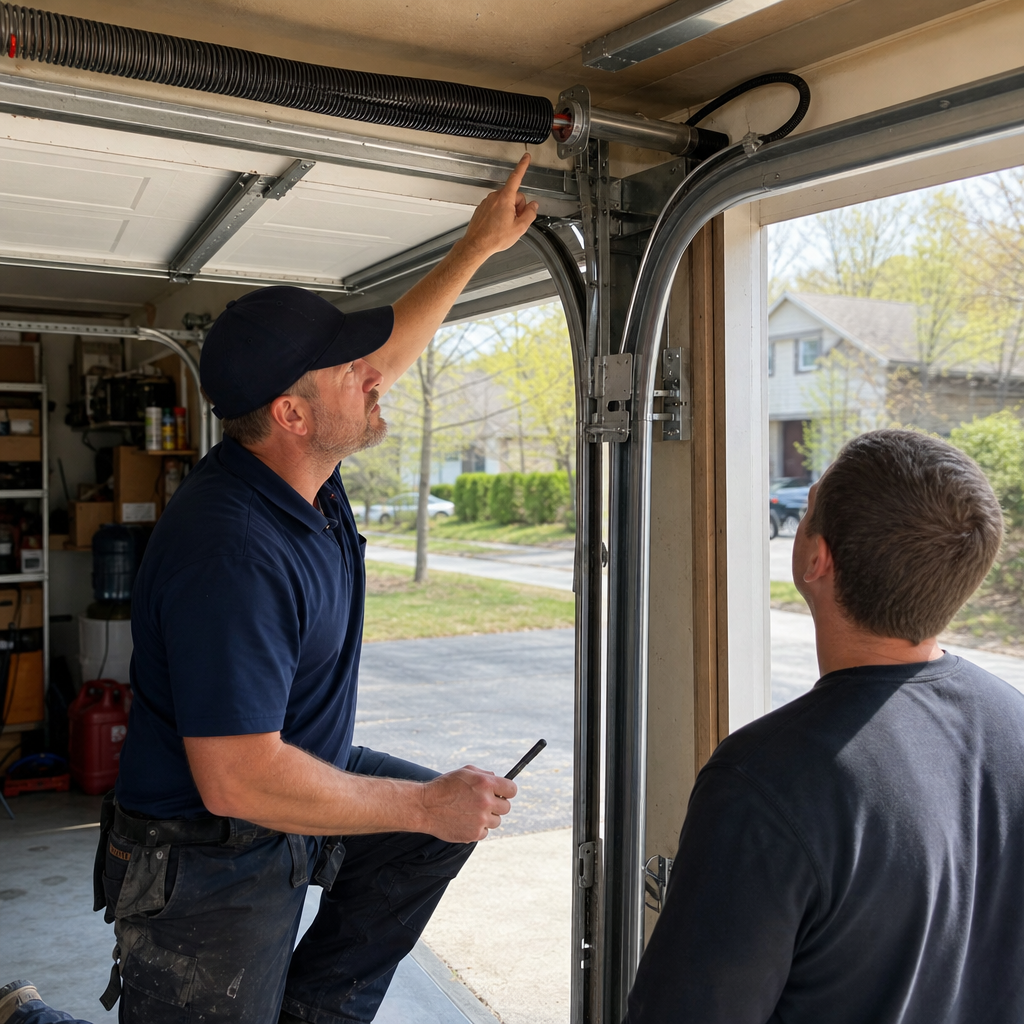
How to Program a Garage Door Opener in West Virginia: The Steps That Actually Work
Programming a garage door opener remote takes about 60 seconds when everything’s working: press and release the “Learn” button on the motor unit until the LED lights, press your remote button within 30 seconds, and wait for the light to flash or click twice. If you’ve done exactly that and the door still won’t respond, the problem usually isn’t your technique—it’s one of three hidden failure modes that don’t appear in the manual. In West Virginia, where spring thunderstorms and winter ice storms knock out power several times a year, we’ve found that programming issues spike the week after major weather events. If you’re stuck, call us at (855) 934-0471 and we’ll walk you through it—or come sort it out same-day.
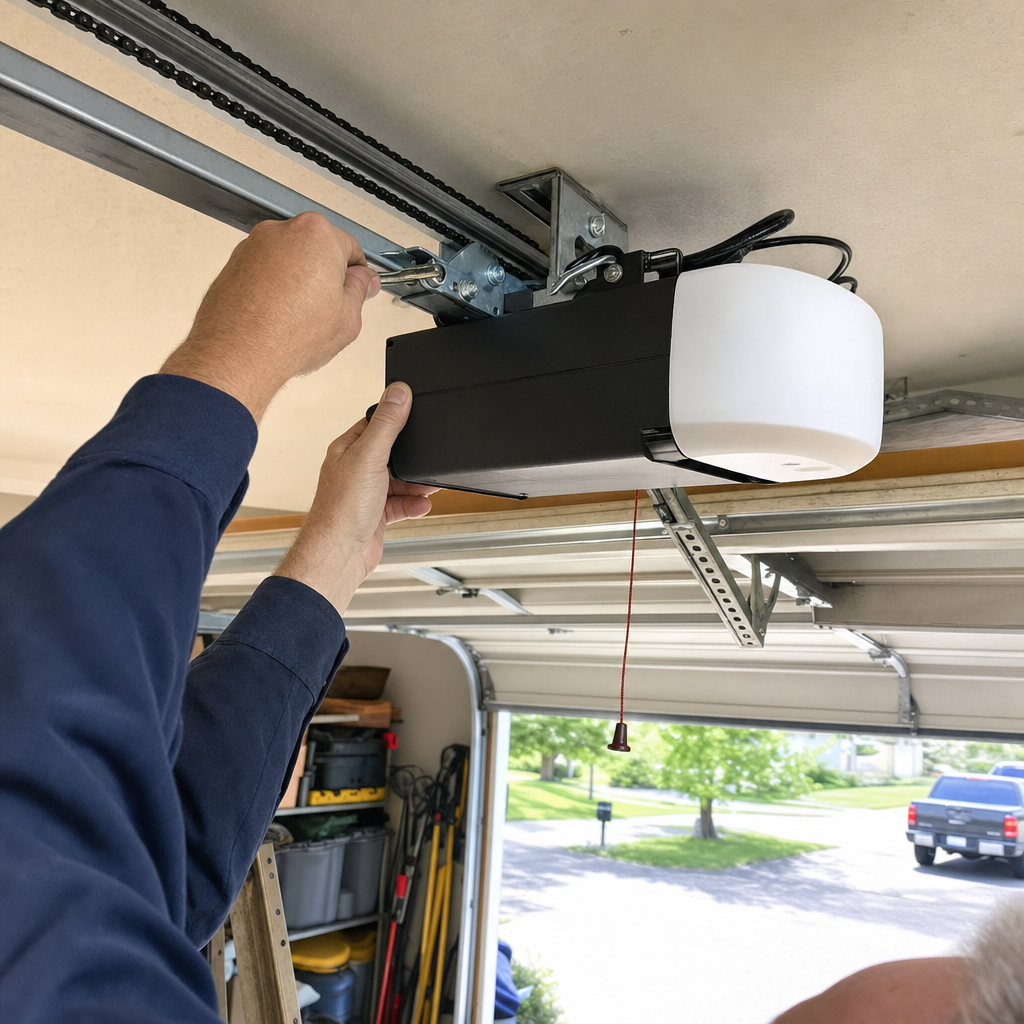
We’re Douglas Ross and the small crew at Halcyon Garage Door Installation, and we’ve programmed, reprogrammed, and replaced more openers across West Virginia than we can count. Over eleven years and nearly 600 reviews, the calls that start with “I watched the video three times” almost always land in one of the three buckets below. Here’s how to diagnose which one is yours, and what to do about it.
Why Most “How-To” Videos Stop Helping Right When You Need Them
The standard programming sequence works fine on a brand-new opener with empty memory and a compatible remote. Real homes in Charleston, Huntington, Morgantown, and the hollers in between don’t work that way. You’ve got remotes from 2019, a keypad the previous owner installed, maybe a universal remote from the hardware store, and an opener that survived the 2012 derecho.
Here’s what the generic guides miss: the “Learn” button color on your LiftMaster or Chamberlain opener tells you exactly which protocol family you’re dealing with, and that determines which remotes will program and which won’t. This isn’t cosmetic—it’s the difference between success and an hour of frustration.
- Yellow Learn button: Security+ 2.0, post-2011. Uses rolling codes on a 900 MHz and 2.4 GHz dual-band signal. Only Security+ 2.0 remotes and keypads will program.
- Purple Learn button: Security+ 315 MHz, roughly 2005–2011. Requires a compatible Security+ remote; newer Security+ 2.0 remotes will not pair.
- Red or orange Learn button: Billion Code or Security+ 390 MHz, pre-2005. These older openers are increasingly incompatible with modern remotes, and many universal remotes won’t touch them.
- Green Learn button: Commercial-grade Security+ 2.0, less common in residential but appearing on newer high-cycle units.
We’ve driven to homes in Kanawha County where a homeowner spent two days trying to program a yellow-button Security+ 2.0 remote to a purple-button opener. The remote isn’t broken. The opener isn’t broken. They’re speaking different languages. Before you buy a replacement remote, check that button color.
The Three Hidden Failure Modes (And How to Fix Each One)
Failure Mode 1: Remote Memory Is Full
Most LiftMaster and Chamberlain residential openers store a maximum of 40 remote or keypad codes. Once that memory fills, the opener silently rejects new programming attempts—no error message, no flashing pattern that tells you why.
Here’s the fix: hold the Learn button for about six seconds until the LED goes out completely. This erases all programmed remotes and keypads. Then reprogram the devices you actually want, one by one. Yes, you’ll need to reprogram everything. No, there’s no way to selectively delete individual codes on most residential units.
We see this constantly in multi-generational homes around West Virginia—grandma’s old remote from 2014, the spare in the glove box, the keypad the kids used before college, the universal remote that half-worked once. They all count against that 40-code limit. In South Charleston last spring, we cleared 37 stored codes from a single opener. The homeowner had been trying to add a new remote for three weeks.
Failure Mode 2: Rolling-Code Desync After Power Loss
West Virginia’s power grid takes a beating. Ice storms in January, derecho remnants in summer, and the odd transformer fire after a car-vs-pole incident on winding mountain roads—all of it sends surges and outages through homes from Wheeling to Bluefield. Some openers, particularly Chamberlain and LiftMaster units manufactured between 2008 and 2016, lose their rolling-code synchronization after a hard power cycle.
The symptom: your remote worked yesterday, the power flickered last night, and now nothing. Not even the wall button works consistently. The opener’s logic board and remote have fallen out of sync in their code sequence.
The fix is the same as a full reprogram: clear all codes with a six-second Learn button hold, then re-pair every remote and keypad. If the problem recurs after every outage, the logic board’s memory capacitor is weakening. That’s not a programming issue anymore—it’s a hardware replacement signal. At that point, Garage Door Opener repair or replacement becomes the smarter money. We stock and service the brands already on your home—LiftMaster, Chamberlain, Genie, and others—and can tell you in ten minutes whether the board is worth saving.
Failure Mode 3: Protocol Mismatch With Pre-2011 Openers
Security+ 2.0 rolled out in 2011 with encrypted rolling codes that change with every use. It’s more secure against code-grabbing devices, but it’s not backward-compatible. A remote manufactured for Security+ 2.0 will never program to a Security+ 390 MHz or Billion Code opener, no matter how long you hold buttons or how close you stand.
The hardware store universal remotes make this worse. They claim “works with 90% of openers,” but that 10% failure rate lands disproportionately on older units in West Virginia’s established neighborhoods—Kanawha City, where Douglas grew up helping his grandfather maintain the old detached garage behind their house; the brick ranch homes built in Huntington’s 1960s subdivisions; the converted summer cottages around Summersville Lake. Those places have character, and they often have openers that predate the Security+ 2.0 standard.
If your opener was manufactured before 2011 and you’re buying a new remote, look specifically for Security+ (not 2.0) compatibility, or call us with your opener model number. We’ll tell you exactly which remote to order, or whether it’s time to discuss Garage Door Opener Installation in West Virginia, WV.
Programming a Keypad: Different Sequence, Same Logic
Most homeowners don’t realize the wireless keypad programs separately from the remote, with its own entry sequence. Here’s how it actually works on the major brands we service:
| Brand | Keypad Programming Sequence | Common West Virginia Models |
|---|---|---|
| LiftMaster/Chamberlain (Security+ 2.0) | Enter 4-digit PIN, press and hold Enter until light blinks, press Learn button on opener, press Enter again | 8550W, 8360W, WLED |
| LiftMaster/Chamberlain (pre-2011 Security+) | Press Learn button, enter PIN on keypad within 30 seconds, press Enter | 3280, 3850, 41A5021 |
| Genie Intellicode | Hold Program/Set until LED blinks, enter PIN, press Up/Down twice, press Learn button on opener, press Up/Down once | ChainLift 1200, SilentMax 1200 |
The critical detail: the keypad PIN and the remote codes occupy the same 40-code memory pool. If you’ve got three remotes and two keypads, that’s five codes toward your limit. We’ve found keypads installed by previous homeowners, forgotten in a drawer, still holding active codes—ghosts in the machine eating memory slots.
Genie Intellicode keypads have their own quirk: they require a fresh battery (not just functional, but above 10.5 volts) to complete programming. A weak battery will let you enter the sequence, see the blinks, and still fail to pair. We keep CR2032 and A23 batteries on the truck for exactly this reason.
When Programming Fails Because the Opener Is Failing
Here’s the honest assessment we give homeowners in West Virginia: if you’ve cleared memory, checked your Learn button color, verified remote compatibility, and the opener still won’t enter programming mode, the logic board’s non-volatile memory is likely corrupted. This happens in openers that have seen 12–15 years of temperature swings—uninsulated garages in Beckley hitting 95°F in July and 10°F in January, condensation cycling through the circuit board twice a day.
The Learn function depends on a small EEPROM chip that stores your codes. When that chip degrades, the opener may run the door fine with existing remotes but refuse to accept new programming. It’s not the remote that’s defective. It’s not your technique. The opener is telling you it’s near end of life.
At that point, opener repair runs $110–$290, and a Best Garage Door Opener in West Virginia, WV installation runs $225–$495. For a unit over 12 years old, we typically recommend replacement—newer units have battery backup (now required in some jurisdictions), Wi-Fi connectivity, and the Security+ 2.0 encryption standard. We install LiftMaster, Chamberlain, Genie, and other major brands, and we’ll match the opener to your door’s weight, cycle frequency, and whether you’ve got a low-headroom track in an older garage.
West Virginia’s Climate: What It Means for Your Opener
Our state’s geography creates specific stress on garage door systems that flatland manuals don’t address. The humidity in the Kanawha Valley corrodes battery contacts in remotes and keypads faster than drier climates. The temperature swings in the mountains—40 degrees in a single day, common in spring and fall—cause expansion and contraction in logic board solder joints. And the power quality in rural co-op territories can be spikier than urban grid power, accelerating capacitor failure.
We keep seeing the same pattern: a homeowner in Putnam County or Raleigh County replaces a remote three times before realizing the opener’s Learn circuit is the actual problem. A quick diagnostic call saves that frustration. Douglas Ross — Owner and Lead Technician — handles your job personally, and we’ll tell you straight whether programming, repair, or replacement is the right path.
Key Takeaways
- Check your Learn button color first—yellow, purple, red/orange, or green determines which remotes will program.
- If programming fails after the standard sequence, clear all codes with a 6-second Learn button hold; memory may be full.
- After any power outage in West Virginia, expect to reprogram remotes if your opener uses rolling-code sync.
- Keypads program with different sequences than remotes and share the same memory limit.
- If the opener won’t enter programming mode at all, the logic board may be failing—replacement is usually more economical than repair on units over 12 years old.
FAQs
Professional remote or keypad programming typically runs $110–$290 if it’s a straightforward sync issue included in a service call. If the opener’s logic board has failed and needs replacement, repair costs stay in that same $110–$290 range; full opener installation runs $225–$495. We don’t charge separately for programming when it’s part of a repair or installation—we’ll have you working before we leave. Call (855) 934-0471 for an exact quote; estimates are free.
The most common hidden cause is a full remote memory—LiftMaster and Chamberlain units stop accepting new codes after 40 stored remotes or keypads, with no error message to warn you. The second most common is a protocol mismatch: you’re trying to program a Security+ 2.0 remote to a pre-2011 Security+ opener, or vice versa. Check your Learn button color (yellow, purple, red/orange, or green) against your remote’s compatibility label. If both check out and it still fails, the opener’s logic board memory may be corrupted, which we see in units over 12 years old that have survived West Virginia’s temperature swings and power fluctuations.
Yes—Emergency Garage Door Opener in West Virginia, WV service is part of our core offering, not an upsell tier, and we carry replacement remotes, keypads, and logic boards for all eight major brands we service. For programming issues specifically, we can often diagnose over the phone whether you need a service call or just the right sequence. When your garage door fails, you don’t have time to gamble on an unknown crew. Douglas Ross still shows up to most jobs himself, and we serve Charleston, Huntington, Morgantown, and surrounding areas across West Virginia.
For openers under 10 years old with a failed logic board, repair at $110–$290 usually makes sense. For openers over 12–15 years old, replacement at $225–$495 is typically the better value—you get current Security+ 2.0 encryption, battery backup, and a new warranty. We’ve replaced openers in homes from Kanawha City to Lewisburg where the homeowner had already spent $80 on two wrong remotes and a universal that didn’t fit. Straightforward diagnosis, honest price, door done right. Call (855) 934-0471 and we’ll tell you which side of that line your opener sits on.
If you’d rather have it looked at, Halcyon Garage Door Installation West Virginia offers a no-pressure assessment anywhere in West Virginia — call (855) 934-0471. A quiet garage door is a safe garage door — let’s keep it that way.
Written by Douglas Ross, Owner & Lead Technician at Halcyon Garage Door Installation West Virginia, serving West Virginia, WV.