
Last updated July 11, 2026
Garage Door Repair Maintenance Checklist for Charleston Homeowners
That squeak you hear every morning? In Charleston’s humidity, it might not be a simple lubrication problem. We’ve found roller tracks pulling away from water-damaged headers that sounded identical to dry rollers — a $15 fix versus a $400 structural repair. Most maintenance checklists online are written by content marketers who’ve never stood in a garage with a homeowner. This guide teaches you to interpret what you find, not just go through motions. You’ll learn pass/fail criteria for every inspection point, which tasks are genuinely dangerous versus merely intimidating, and how Charleston’s wet climate changes what “normal wear” looks like. In 20 minutes, you’ll know whether your door is healthy, needs monitoring, or needs Douglas Ross — Owner and Lead Technician at Halcyon — on the phone.
Quick Answer
A proper garage door maintenance checklist for Charleston homeowners takes 20 minutes and covers six areas: visual hardware inspection, balance and reversal testing, roller and track condition, weather seal integrity, opener force settings, and rust assessment calibrated to our local humidity. Do this twice yearly — April after winter freeze-thaw cycles, and October before heating season traps moisture indoors. Stop immediately and call a professional if you find frayed cables, loose spring mounts, or a door that won’t stay open at waist height.
Table of Contents
- What You’ll Need (and What You’ll Never Need)
- Visual Hardware Inspection: Pass/Fail Criteria
- Balance and Reversal Testing
- Rollers, Tracks, and Charleston Humidity Damage
- Weather Seals and Energy Efficiency
- Opener Force and Safety System Check
- Rust Assessment: Charleston’s Accelerated Timeline
- Documenting Your Door’s Condition Over Time
What You’ll Need (and What You’ll Never Need)
We’ve watched homeowners over-prepare and under-prepare in equal measure. Here’s the actual kit:
- A sturdy step ladder — 6-foot stepladder for standard 7-foot doors, 8-foot for 8-foot doors. Never use a folding chair.
- Flashlight — even bright garages have shadowed corners where hardware hides.
- Shop rag — for wiping grease to inspect underlying metal condition.
- Smartphone camera — documentation is half the value of this exercise.
- WD-40 or similar light penetrating oil — for cleaning, not lubricating. We’ll explain the difference.
- Silicone-based garage door lubricant — white lithium grease or dedicated garage door spray. Never use standard WD-40 as a lubricant; it evaporates and attracts dust.
- Work gloves — metal edges and old grease are unforgiving.
What you don’t need: winding bars, cable pullers, or spring adjustment tools. These are for trained technicians only. Torsion springs store lethal energy — we’ve seen experienced tradespeople injured by improper handling. Douglas Ross carries specialized winding bars and tension gauges on every Charleston call because the risk-reward math of DIY spring work is indefensible.
Time commitment: 20 minutes for a standard residential door. Add 5 minutes if you’re photographing and annotating for the first time.
Visual Hardware Inspection: Pass/Fail Criteria
Start with the door closed and opener disconnected (pull the red emergency release cord). This eliminates motor movement during your inspection.
Hinges and Brackets
Pass: All bolts present, no visible cracks in metal, no elongation of bolt holes. Hinge knuckles move freely when manually flexed.
Fail — call a pro: Cracked hinge bodies (common on stamped-steel hinges after 8-10 years), bolts missing or backed out more than one thread, elongated holes indicating bolt slippage under load. In Charleston, we see accelerated hinge corrosion where garage humidity exceeds 70% regularly — surface rust is monitorable; pitting that weakens the hinge body is replacement territory.
Cables and Cable Drums
Pass: Cables seat cleanly in drum grooves, no fraying visible along full length, no rust blooming on individual strands.
Fail — call immediately: Any fraying (even three broken strands), cable unwrapping from drum, or “bird-caging” where strands bulge outward. Cable failure drops doors without warning. We’ve responded to emergency garage door service calls in Charleston’s South Hills and Kanawha City neighborhoods where cables snapped during morning departures — always at the worst moment.
Spring Mounts and Hardware
Pass: Stationary cones and winding cones secure to header bracket and torsion tube; no visible cracks in castings; set screws tight (do not attempt to tighten — observation only).
Fail — call immediately: Any looseness in spring mount brackets, cracking in header wood where bracket attaches, or gap between spring coils indicating failure. A gap in a torsion spring means it’s broken — even if the door still operates with opener assistance. The opener is now doing 100% of the lifting work and will fail prematurely.
Pass/Fail Summary Table
| Component | Pass | Fail — Action Required |
|---|---|---|
| Hinges | Intact, bolts tight, free movement | Cracks, missing bolts, elongated holes → Schedule repair |
| Cables | Clean seating, no fraying | Any fraying or unwrapping → Call same day |
| Spring mounts | Secure, no cracks | Loose brackets, header damage → Call same day |
| Bottom brackets | Secure to door, cables attached | Any looseness → Call immediately (under tension) |
Balance and Reversal Testing
This two-part test reveals whether your door’s mechanical systems are doing their jobs or hiding problems.
Balance Test
Disconnect the opener. Manually lift the door to waist height (approximately 3 feet). Release gently.
Pass: Door stays within 6 inches of where you released it, either holding position or drifting slowly.
Fail: Door crashes down (springs too weak or broken) or shoots upward (springs over-wound or incorrect for door weight). Either condition strains your opener and creates safety hazards. In our 11 years serving Charleston, we’ve found that doors installed by non-specialists — general contractors adding garage doors as a sideline — are disproportionately likely to have spring-mismatch problems. Douglas Ross verifies spring specification against door weight on every Garage Door Repair in Charleston call.
Reversal Test
Reconnect opener. Place a 2×4 board flat on the floor centered under the door path. Close the door using the wall button (not remote — you need visual contact).
Pass: Door contacts board and reverses within 2 seconds.
Fail: Door fails to reverse, reverses before contact (false trigger), or stalls on board without reversing. All indicate force-limit adjustment problems or sensor misalignment.
Critical safety note: Garage door openers manufactured before 1993 may lack automatic reversal — if your opener lacks this feature, replacement is strongly advised regardless of apparent function. We stock and service current LiftMaster, Chamberlain, and Genie units with full safety compliance.
Rollers, Tracks, and Charleston Humidity Damage
This is where Charleston’s climate becomes your primary inspection variable. Our average annual humidity hovers near 70%, with summer spikes above 80% that accelerate metal fatigue and wood movement.
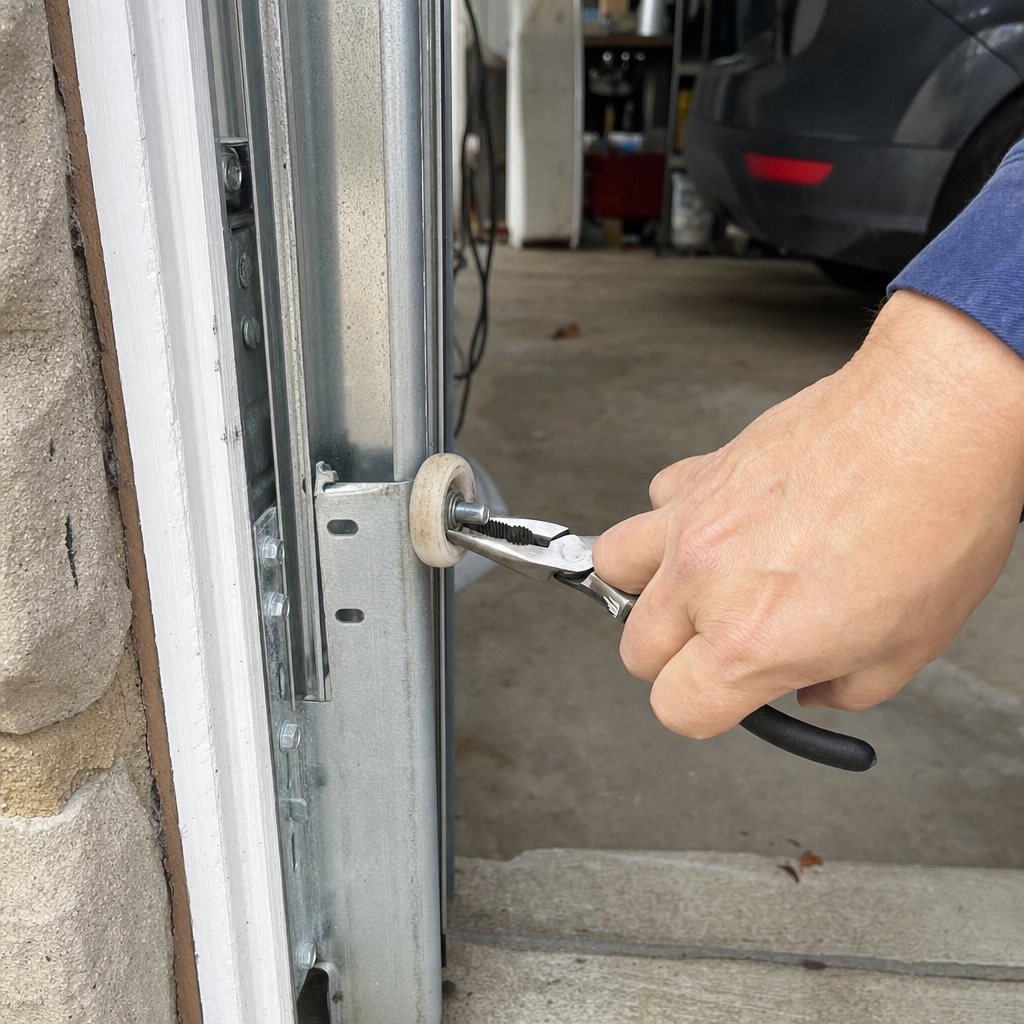
Roller Condition
Rollers come in three types, and what you find determines your maintenance path:
- Steel rollers with unsealed bearings: Most common on builder-grade installations. Inspect for bearing wobble, grinding noise when door moves, and rust on bearing races. These need replacement every 5-7 years in Charleston conditions — we’ve pulled steel rollers from Kanawha County doors that were seized solid after 4 humid summers.
- Steel rollers with sealed bearings: Longer lifespan, but seals can fail. Look for grease leakage or grit accumulation around seal edges.
- Nylon rollers with sealed bearings: Quietest operation, generally 10-12 year lifespan. Inspect for nylon wheel cracking — rare but catastrophic if it occurs.
Pass: Rollers sit squarely in track, no lateral wobble, smooth rolling sound, no visible rust on bearing surfaces.
Fail: Wobble exceeding 1/8 inch, grinding or clicking during operation, visible rust blooming, or roller popping from track during manual movement. Any of these — schedule replacement. Don’t lubricate failing bearings; it masks the problem temporarily and accelerates wear.
Track Alignment and Mount Integrity
Here’s where that opening hook becomes relevant. In Charleston’s older neighborhoods — South Hills, East End, parts of Kanawha City — we regularly find header boards (the wood framing above your door opening) that have absorbed decades of humidity cycles. The track mounting lag screws loosen as wood fibers compress and expand.
Inspection: Sight along the vertical track from floor to curve. It should be plumb (perfectly vertical). Check where vertical track meets horizontal — the radius should be smooth, not angular.
Pass: Track plumb within 1/4 inch over 7 feet, all mounting brackets secure, no gap between bracket and wall surface.
Fail: Track visibly out of plumb, brackets pulling away from wall (often with stripped lag screw holes), or radius section showing flattening from door impact. That squeak you assumed needed lubrication? If the track is pulling away, the roller is binding against misaligned metal — lubrication won’t fix structural movement, and delaying repair risks door derailment.
What you can safely do: Tighten accessible bracket bolts with a socket wrench — only if the bracket remains flush to the mounting surface and the bolt turns freely without stripping. If the bolt spins without tightening, the wood behind is stripped and needs professional repair with larger fasteners or epoxy-filled holes.
Weather Seals and Energy Efficiency
Charleston’s temperature swings — from single-digit winter lows to humid 90-degree summers — make weather seal integrity a year-round comfort and cost issue. A failed bottom seal can raise heating costs measurably in older homes with attached garages.
Bottom Seal (U-Shaped or Bulb Type)
Pass: Flexible, no cracking or permanent compression set, contacts floor evenly across full door width. Light visible through corners only (normal for sloped floors).
Fail: Rigid or cracked vinyl/rubber, daylight visible along center section, seal retainer pulling from door bottom. Replacement is straightforward — we stock common profiles and can walk you through measurement if you’re handy, or handle it on a service call.
Side and Top Seals (Vinyl or Brush)
Pass: Intact attachment to door frame, flexible contact with door surface, no gaps exceeding 1/8 inch.
Fail: Brittle vinyl cracking away from retainer, brush strips missing clumps, or seal completely detached. In Charleston’s sun-exposed west-facing garages, UV degradation accelerates — we’ve replaced side seals on Edgewood and Fort Hill doors that failed in 3 years versus the typical 7-10.
Threshold Seal (Floor-Mounted, if Present)
Less common but valuable for flood-prone properties. Inspect for adhesion failure — Charleston’s freeze-thaw cycles separate poorly bonded thresholds from concrete. Water infiltration under a failed threshold accelerates everything else.
Energy note: If your garage is attached and your bedroom wall shares it, seal condition directly affects sleep quality. We’ve had Charleston homeowners report noticeable temperature improvement after seal replacement alone.
Opener Force and Safety System Check
Modern openers — LiftMaster, Chamberlain, Genie, and others we service — include force-limiting circuits and photoelectric sensors. These require verification, not just assumption.
Photoelectric Sensors (Photo Eyes)
Located 4-6 inches above floor on both track sides. Small LED indicators show alignment status — consult your opener manual for your model’s specific indicator (steady, blinking, color-coded).
Pass: LEDs show aligned status, door reverses when object breaks beam during closing cycle, sensors clean and unobstructed.
Fail: Blinking or off LEDs, door continues closing when beam broken, or sensors knocked out of alignment (common when garbage cans, bikes, or car bumpers contact them). Realignment is often simple — loosen wing nut, adjust until LEDs indicate alignment, retighten. If alignment won’t hold or LEDs remain abnormal, wiring or sensor replacement may be needed.
Charleston-specific: Spider webs across sensor lenses are surprisingly common in our humid summers — clean gently with dry cloth, don’t spray cleaners that leave residue.
Force Limit Test
With door fully open, initiate closing from wall button. During travel, grasp bottom of door firmly and apply upward resistance.
Pass: Door reverses within approximately 1 second of resistance application.
Fail: Door continues closing against resistance, or requires excessive force to trigger reversal. Both indicate force-limit adjustment needed — a task we recommend for professionals, as over-adjustment creates crushing hazard and under-adjustment causes nuisance reversal on windy days or slight track irregularities.
We verify force settings with calibrated test equipment on every Garage Door Opener in Charleston service call — it’s not guesswork, and your family’s safety isn’t a place for approximation.
Rust Assessment: Charleston’s Accelerated Timeline
This section doesn’t appear on generic checklists because most writers don’t live with our humidity. Charleston homeowners need a rust inspection cadence that would be excessive in Phoenix and insufficient on the coast.
The Charleston Rust Calendar
Our service area spans river valley microclimates with varying exposure. Here’s what 11 years of field observation tells us:
- Spring (March-May): Peak rust activation. Winter salt residue from road spray meets warming humidity. Inspect hardware, especially bottom fixtures and lower track sections, by mid-April.
- Summer (June-August): Humidity-driven surface oxidation on unprotected steel. Less dramatic than spring but relentless — ideal conditions for rust establishment.
- Fall (September-November): Secondary inspection window before heating season traps garage moisture. Check seals that may have degraded over summer, allowing water intrusion.
- Winter (December-February): Freeze-thaw cycling cracks paint and galvanizing, exposing fresh metal. Monitor after each significant thaw.
Rust Grading System
Not all rust demands immediate action. Use this framework:
| Grade | Appearance | Action |
|---|---|---|
| 1 — Surface | Light orange discoloration, wipes away revealing intact metal beneath | Clean, dry, apply rust-inhibiting primer if accessible |
| 2 — Pitting | Visible texture change, small pits forming, doesn’t wipe clean | Monitor monthly, schedule professional assessment — may be salvageable with treatment |
| 3 — Structural | Flaking metal, holes, or section weakening visible | Replace component — do not attempt repair |
Critical rust zones in Charleston: Bottom fixtures (road splash zone), lower 18 inches of vertical track, spring hardware in unconditioned garages, and any hardware on doors facing prevailing rain exposure. We’ve replaced track sections in Elkview and Cross Lanes where Grade 3 rust developed in 6 years — half the expected lifespan — due to garage moisture management issues.
Documenting Your Door’s Condition Over Time
This is the single most valuable habit that no checklist teaches. When you call for service — whether Halcyon or another provider — your documentation transforms diagnosis from exploratory to targeted.
The 5-Photo Baseline
- Full door, closed, exterior: Captures panel condition, paint/finish state, obvious damage.
- Full door, closed, interior: Shows hardware layout, opener rail position, any interior-side damage.
- Spring assembly, close-up: Document coil spacing, rust grade, mount condition. Date this photo — spring aging is progressive and comparison over time reveals acceleration.
- Track and roller detail, both sides: Mid-height capture showing roller type, track condition, bracket security.
- Bottom seal and floor interface: Shows seal condition and any floor damage, water staining, or threshold issues.
Store these with dates in a dedicated phone album or cloud folder. Add dated notes: “April 2025 — slight roller noise starting, left side,” or “October 2025 — seal still good after replacement last year.”
Why this matters: When Douglas Ross arrives for a Garage Door Installation in Charleston consultation or repair, showing him a 3-year photo sequence of spring condition tells him more than 10 minutes of verbal description. He can see whether deterioration is linear (predictable) or accelerating (urgent). For Halcyon Garage Door Installation West Virginia home customers, this documentation often converts uncertain “should we repair or replace?” conversations into clear decisions with confident timelines.
Maintenance log template: Date, tasks completed, findings (Pass/Fail per section above), photos added, professional service date if applicable. Two years of this log is worth more than any extended warranty for predicting and preventing failures.
Common Mistakes to Avoid
- Lubricating everything that moves. Nylon rollers, plastic idler pulleys, and belt-drive opener tracks never need lubrication — it attracts dust and degrades materials. Only lubricate steel hinges, steel roller bearings, and chain/screw drive mechanisms per manufacturer specification.
- Ignoring the “small” squeak. In Charleston’s humidity, that squeak often signals track misalignment or water-damaged mounting structure, not simple dryness. Lubricating a misaligned track masks progressive damage until derailment occurs.
- Testing reversal with a person instead of a board. The 2×4 test is standardized for a reason. Using your hand or foot introduces inconsistent pressure and injury risk if the system fails.
- Assuming “it still works” means “it’s fine.” A door that opens with opener assistance despite broken springs is actively destroying the opener gear assembly. We’ve replaced $400 openers that failed because homeowners delayed $200 spring repair.
- Using the wrong lubricant. Standard WD-40 is a solvent, not a lubricant. It cleans, then evaporates, leaving metal exposed. Use white lithium grease or dedicated garage door lubricant. We’ve cleaned gummy residue from Charleston doors where homeowners used motor oil or silicone spray on incompatible surfaces.
- Neglecting the emergency release. Test monthly — if the red cord won’t disengage or re-engage smoothly, you’re trapped if the opener fails during a power outage. In 2024’s summer storms, we fielded multiple Charleston calls from homeowners who couldn’t manually open doors when openers lost power.
- Skipping documentation because “I’ll remember.” You won’t. And neither will the next homeowner if you sell. Documentation transfers with the property and prevents redundant professional assessment.
When to Call a Professional
Stop your inspection and call if you find: any cable fraying or damage, spring gaps or broken coils, door that won’t pass the balance test, track mounting pulling away from wall structure, opener force limits that fail testing, or rust beyond Grade 2 pitting. These aren’t maintenance items — they’re safety-critical repairs requiring specialized tools and training.
Halcyon Garage Door Installation West Virginia offers free estimates in Charleston — call (855) 934-0471. Douglas Ross — Owner and Lead Technician — handles your job personally, bringing 11 years of single-trade specialization and factory familiarity with LiftMaster, Chamberlain, Genie, Raynor, and four additional major brands. When your garage door fails, you don’t have time to gamble on an unknown crew. Straightforward diagnosis, honest price, door done right.
Frequently Asked Questions
Professional maintenance inspection and tune-up in Charleston typically runs $89–$150, with repairs additional based on findings. Halcyon provides upfront pricing before any work begins — call (855) 934-0471 for exact current rates and availability.
No. Torsion springs store enough energy to cause serious injury or death if improperly handled. Winding bars, tension gauges, and controlled release techniques require training and experience. We’ve responded to emergency calls where DIY attempts made simple problems dangerous and expensive. This is unequivocally a professional-only task.
Twice yearly: April, after winter freeze-thaw stress, and October, before heating season increases garage humidity. Add an inspection after any significant weather event — the 2016 and 2024 flood events in Charleston revealed damage that routine timing would have missed.
Humidity causes metal expansion and lubricant thinning, but persistent noise increase often indicates water infiltration into bearings or track mounting looseness from wood swelling and contraction. In Charleston’s river valley climate, we distinguish seasonal variation from progressive failure by whether noise persists after dry spells — persistent noise needs professional assessment.
Repair is typically more economical when the door is under 15 years old, damage is isolated to hardware or panels, and the door style matches your home’s current aesthetic. Replacement becomes cost-effective when multiple panels are damaged, insulation values are outdated, or repair costs exceed 50% of replacement. Douglas Ross provides both repair and replacement estimates so Charleston homeowners can compare actual numbers, not assumptions.
Steel doors with proper maintenance last 20–30 years; wood doors 15–20 years with diligent sealing; aluminum and fiberglass 20–25 years. Charleston’s humidity shortens these ranges by 10–15% compared to drier climates unless rust prevention and seal maintenance are prioritized. We’ve maintained doors in Charleston that exceeded these ranges through disciplined homeowner care, and replaced others that failed early due to neglect.
The Bottom Line
This checklist takes 20 minutes twice yearly and replaces uncertainty with actionable knowledge. You’ll know whether that squeak is harmless or a $400 problem developing. You’ll catch cable wear before it strands your car. You’ll document condition so future service calls start with facts, not guesses. Most importantly, you’ll know which tasks are within your capability and which require the trained hand of a specialist — particularly anything involving spring tension or cable systems. For Charleston homeowners who’ve experienced the frustration of unreliable contractors, this checklist is also a filter: any professional who won’t review your documentation or explain their findings in these terms may not be the technician you want in your garage.
Ready for a professional assessment or need help with findings from your inspection? Halcyon Garage Door Installation West Virginia serves Charleston with owner-operated expertise built on nearly 600 five-star reviews over 11 years. Call (855) 934-0471 for a free estimate — Douglas Ross answers personally, and when you schedule service, the person diagnosing your door is the same person who built the business on doing them right.
Written by Douglas Ross, Owner & Lead Technician at Halcyon Garage Door Installation West Virginia, serving Charleston since 2015.